
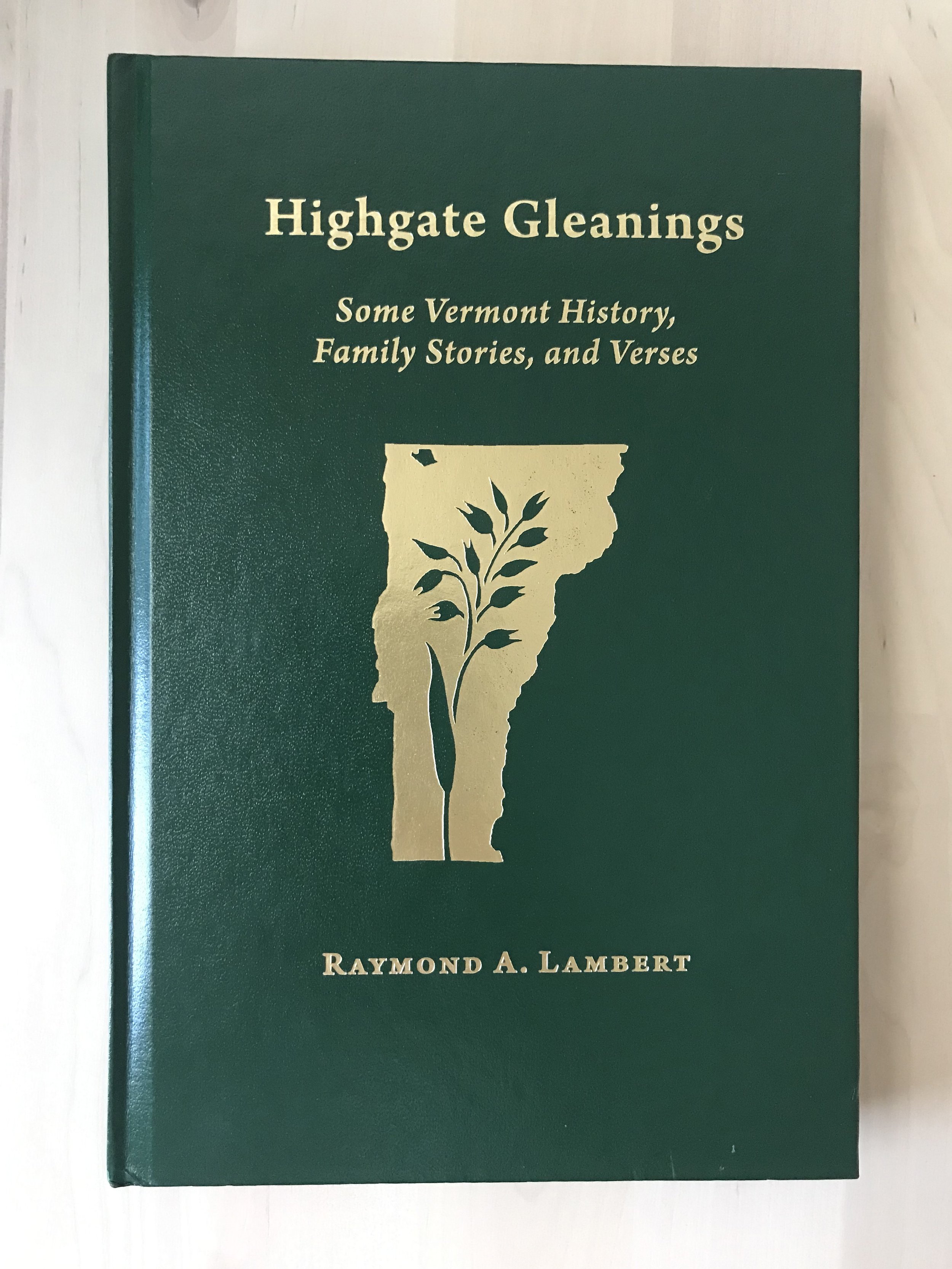
Raymond A. Lambert, father of company president Megan St. Marie, published his book, Highgate Gleanings: Some Vermont History, Family Stories, and Verses, with Modern Memoirs in 2020. This memoir and family history book took about eight months to complete and was one of the first projects Megan worked on after coming to Modern Memoirs. She’s often said that working on this book with her father was one of the most meaningful experiences of her life, as it not only gave her practical experience in her early days as company president, but also affirmed her belief in the value of life-review writing and intergenerational storytelling as means of self-discovery and deepening familial connections. We asked Ray to reflect on what the publication process was like for him as he worked with Megan and Director of Publishing Ali de Groot, who oversaw design and production phases, and what it has meant to share his book with others.
1. You came to the Modern Memoirs office with binders and file boxes filled with years’ worth of writings, photographs, documents, and genealogy information, saying “There’s a book in here!” How does the resulting structure of Highgate Gleanings incorporate those various materials and evoke its title’s meaning?
Raymond A. Lambert: The title, Highgate Gleanings, represented in the cover art and on part-start pages by a single oat stalk with oats ready to be gleaned, indicates that the gleanings contained in those four parts of the book come from many life experiences. The subtitle with its reference to various categories of these gleanings, Some Vermont History, Family Stories, and Verses affirms the wide range of material included in the book.
I did not attempt to write a chronological narrative of my life. That would have required much oversight with necessary corrections for the narrative to flow. Instead, Megan helped me in in the editorial process by creating a four-part structure around the themes of place (“Where I’m From”), heritage (“Who I’m From”), identity (“The Man I Am”), and spirituality (“Heart and Soul”).
2. What part of the publishing process surprised you, or gave you new insights into your life’s story or family history?
Raymond A. Lambert: I can’t say anything surprised me because I did not know what to expect! While I wrote the three required theses for my graduate degrees (M.A. in Religious Education at Catholic University, M.A. in School Guidance at St. Michael’s College; M.A. in School Administration at Castleton State College) and made a few copies of those papers to have on hand in case anyone might be interested in them, publishing a book was a totally new experience for me. It was easy to place my trust in Megan’s editorial work, and Ali de Groot was most helpful during the pre-publication process and oversight of the printing.
Two additions to my original materials perhaps deserve some comment here: Megan suggested that I include an epigraph at the front of the book in my own handwriting, as well as a “Legacy Letter” at the end of the book. It was easy for me to choose the epigraph, a favorite Bible verse that expresses a guiding principle of my faith: “Those who dwell in love dwell in God, and God in them,” (1 John 4:16). I hadn’t ever considered writing a Legacy Letter before, but with Megan’s encouragement, I wrote a draft that we then edited to capture the intangible gifts of love, values, hopes, and life lessons that I want to pass on to my loved ones.
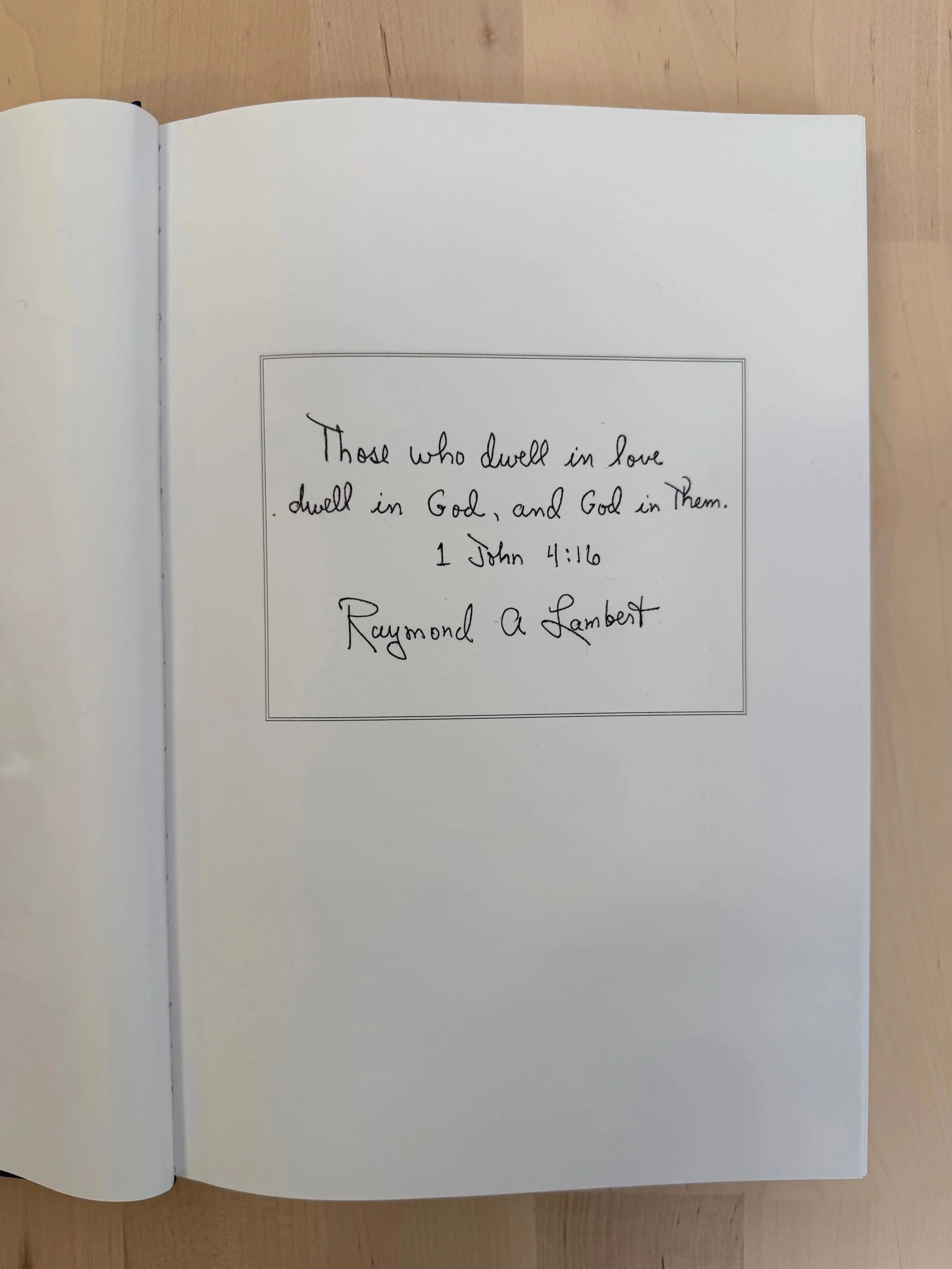
Handwritten epigraph from Highgate Gleanings: Some Vermont History, Family Stories, and Verses
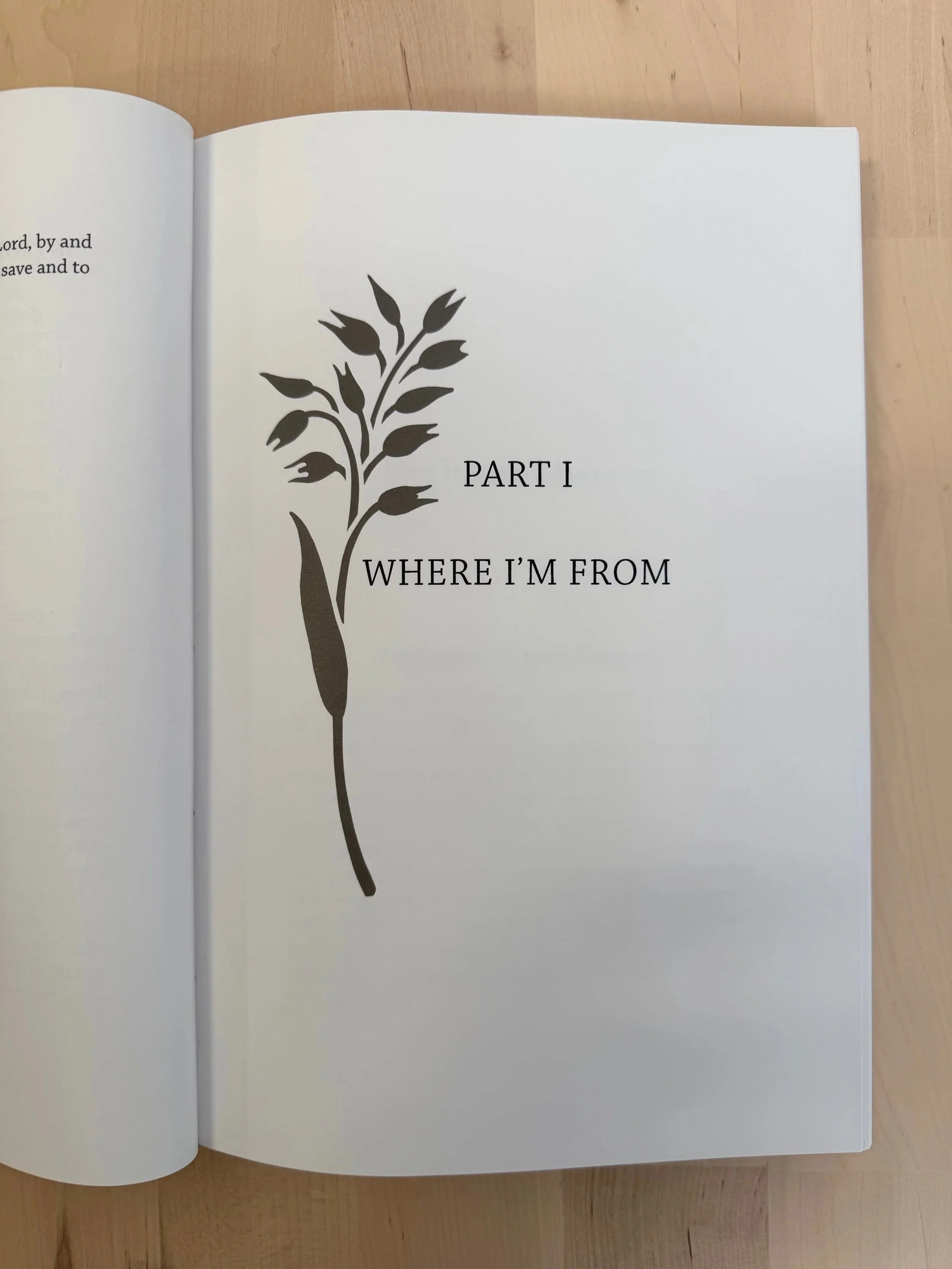
Illustrated part opening page from Highgate Gleanings: Some Vermont History, Family Stories, and Verses
3. You’ve researched your family history for decades, and your book includes some content from that work. What other parts of that research would you like to highlight here that didn’t make it to print?
Raymond A. Lambert: At last count, I’ve documented over 54,000 relatives on my family history website, with most of my ancestors traced back to France and French Canada. I share some family history in Highgate Gleanings, but it’s not a genealogy book with a comprehensive, sourced account of my lineage and ancestor and descendant charts. That would be a massive undertaking!
Discoveries of some rather interesting ancestors and relatives who immigrated to North America, particularly to Quebec and Acadia (now Nova Scotia), have prompted me to think about compiling a book with biographies of some of them. I feel particularly drawn to the stories of my Acadian relatives and ancestors who were impacted by Le Grand Dérangement, or the Great Expulsion, carried out by British colonial leaders in North America during the mid-eighteenth century. In his book A Great and Noble Scheme, historian John Mack Faragher refers to Le Grand Dérangement as the first instance of state-sponsored ethnic cleansing in North America. Out of a population of 18,000 Acadians alive at that time, I have found over 2,100 who are relatives and sixteen who are my direct ancestors. Included among those relatives and ancestors are some of the 10,000 Acadians who died as a result of this terrible moment in history, or about 56% of the population. Those who survived became a diasporic population, often acculturated and assimilated into the places where they ended up—the North American British colonies, England, France, Quebec—though one group of expelled Acadians decided to put down roots in present-day Louisiana, and we know their descendants today as the Cajuns.
A few years ago, Megan and I gave an online presentation based on my genealogy research, “Pain at the Root: Le Grand Dérangement and Our Family History,” hosted by the Franco American Centre at the University of Maine-Orono. My research continues with the expectation that there are many more Acadian relatives to be found. A trip to Nova Scotia a few years ago with visits to embarkation points was a very emotional experience. Who would have thought that genealogical research would do that?
“I invited people to crowd-fund the printing cost, and I was thrilled when dozens upon dozens of people made contributions to pay for their own copies.”
4. How does the book’s cover and its interior design support its written content?
Raymond A. Lambert: The cover is really an invitation to explore within. The map superimposed on the green cover evokes Vermont as the Green Mountain State. The single oat stalk bearing its grains hints at the contents to be gleaned, un-shucked, or harvested by the reader. The small green space in the northwest corner bordering Quebec, Canada depicts the town of Highgate, where my twelve siblings and I were raised. The homestead in Highgate is now owned by a brother-in-law, who was married to my sister, Barbara. After Barbara’s death, he remarried, and he and his wife continue to host an annual family reunion at the homestead, bringing family members back for potluck, catching up, and what has been called a “no-talent show.” Truth be told, however, there are some very talented musicians, singers, and storytellers among us.
The interior design of the book lends itself to reading the contents randomly. The table of contents works something like an index with parts, chapters, and many subheadings. Though the foreword might help the reader grasp the spirit and intent of the contents, it is not necessary to start from the beginning of the book. Reading any gleaning that might beckon is in order. Open the book to any page, and read on.
5. How have you shared your book with others? What are some of the best responses you’ve received?
Raymond A. Lambert: In the foreword to the book I wrote, “This collection of gleanings, stories and memories and some doggerel (bad poetry) is intended for my brothers and sisters, children, grandchildren, nieces and nephews, friends, and neighbors, and some folks in my hometown, Highgate, Vermont. Read as and if you wish.” Since I have such a large extended family, I invited people to crowd-fund the printing cost, and I was thrilled when dozens upon dozens of people made contributions to pay for their own copies, and in many cases, to cover the cost of copies for other people. It’s been very rewarding to see family and friends enjoying the book. Just recently, I learned that my youngest brother’s ten-year-old granddaughter often rereads it to learn more about her ancestors and relatives.
The Highgate Public Library invited me to give a talk about the book soon after it was published, and that was a treat. Others have commented about individuals mentioned in the book and some of the Highgate town history. I must say that the most endearing response I have received has been from my daughter Megan St. Marie, which she writes about in the Introduction to this piece. If any parent-and-child pair reading this blog has the inclination to work together on a project like this, don’t hesitate! The gifts of writing, reminiscing, and sharing will be ones you’ll always treasure, in addition to the book you create.
Megan St. Marie is president of Modern Memoirs, Inc.