
A blog post by Publishing Intern Pam Gainer
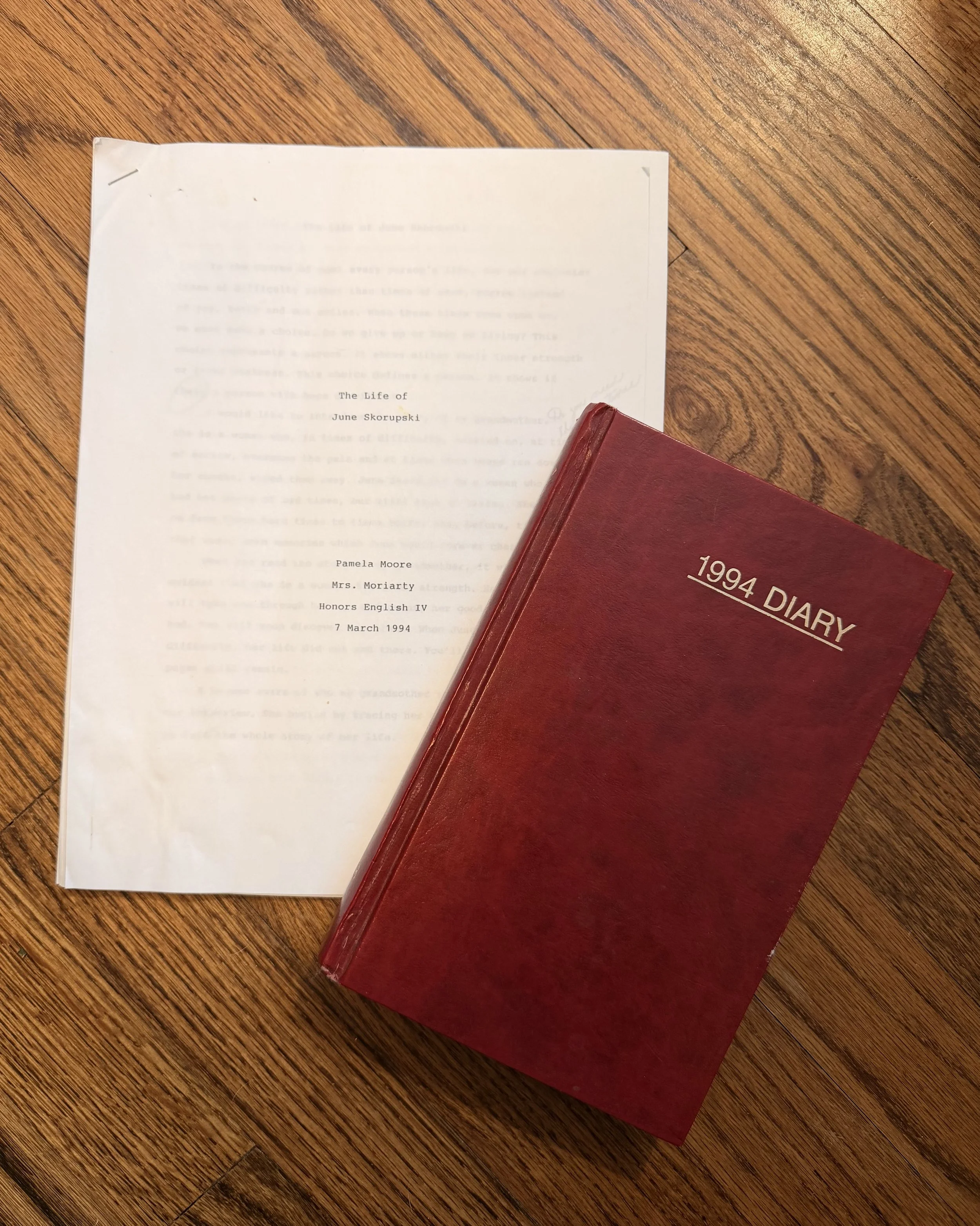
A printout of the interview-based biography that I wrote about my grandmother as a high-school assignment in 1994, alongside one of my grandmother’s page-a-day journals from the same year
I was shopping at an indoor flea market when I saw the grass-green plastic tray sitting on the floor, propped up against a piece of furniture in a booth. It was just the tray; the rest of the metal apparatus that had once made it a tray table was missing. It caught my eye because my maternal grandmother, June, had owned one just like it.
It’s funny the details you remember. I grew up next door to my grandmother and was in and out of her house all the time. My most vivid memories are of seeing her sitting in her recliner in her TV room, with that green tray table beside her. In my memory, it is covered with all manner of things—newspapers, a teacup, an empty plate with some crumbs left over from her toast or crackers, pens, pencils, a letter opener, some mail, and a round handheld magnifying mirror with tweezers for plucking her chin hairs. (She’d laugh if she saw I included those here.) And it always held her maroon hardcover page-a-day journal, with the year stamped in gold lettering on the front.
Today, I live in my childhood home with my family, and my brother and his family live next door in what was our grandmother’s house. My childhood bedroom is now my office, where my grandmother’s journals sit on my bookcase. There are eleven in all, one for each year from 1986 through 1996. Her entries become increasingly sparse and sporadic in the last few years. The final 1996 journal is mostly blank, and she passed in 1997. Year after year, she recounts the details of her days—the weather, what she made for Sunday dinner, who came to visit, and what my family had going on next door. I’ve scoured the pages, looking for something beyond those ordinary moments. There are a few, very rare, moments of emotion. Sometimes I can fill in details beyond what the words share, based on what I know now about her life and our family’s history.
I’ve heard it said that the mid-thirties is the age when life catches up with a lot of us, when we stop and look around and start to question what we’re doing. And that’s what happened to me. I followed the rules I had learned from my family and from society, yet I felt unfulfilled, anxious, and mostly I felt confused. I started questioning all I learned. Part of that process has involved looking back and piecing together my family’s history, with the intention of getting a broader picture of the forces that got me here. My grandmother’s story is a huge part of this.
June was a woman before her time, one who always worked outside the home and took care of her extended family. As a youth, the eldest of five children, she was expected to help at home. When any of her younger siblings got into trouble, she did, too. As a teenager during the Great Depression, she left school early each day to go to work at The New England Homestead Magazine. She loved being able to work and made herself indispensable, turning that high school job into a career. Eventually, she worked her way up to the advertising department, handling classified advertising, and later, display advertising. After marrying, June left the magazine to help my grandfather run the family’s gas station and oil delivery business. When he passed away unexpectedly in 1976, she took over and became the first woman to be granted a contract to sell Mobil Oil-branded gasoline in the United States.
During my senior year in high school, we were assigned to write a biography about someone we knew, and I chose my grandmother June. I sat on her red chenille couch and interviewed her as she sat in her recliner across the room, with the grass-green tray table beside her. All the facts mentioned above came from her telling me her story that day. I must have asked her if she had learned anything over the course of her life that she wanted to share, because the biography concludes with her assertion, “All you really need to do is wear a smile, and everything will turn out to be just fine.”
“What if I had never interviewed her? Who would know this?”
Today, it still amazes me that most of what I know about her life is because of that biography assignment. Just as her journal entries are short on emotional or personal information, our family isn’t one to talk about challenging or tender topics. But during that interview, she opened up. My mother, June’s own daughter, told me that she didn’t even know much of what was in those seventeen pages I wrote in 1994. For example, when June married her first husband in 1939, she kept her marriage secret because it was common that companies wouldn’t employ married women. Then, when they were buying a home in 1940, the bank based their purchase on her husband’s income only. And then there’s the tragic story of her first husband dying of appendicitis in 1945 while he was in the Navy and they were stationed in California. June was pregnant and returned to Massachusetts by train, alone. I sometimes think, “What if I had never interviewed her? Who would know this?”
My grandmother started writing in her journals after she retired. She wouldn’t have had time to write while she was working and taking care of everyone. Did she start keeping the journal because she was bored after she retired? Was she always interested in writing, maybe because of her time working at The New England Homestead? Today, I scour my grandmother’s journals looking for clues about how she felt about her life, her work, and her family. I wonder about so much. I want to ask her, “What did that feel like for you? What do you think? We’re you afraid?” I do a lot of speculating.
The last page of her biography notes my sources. It says the interview with my grandmother took place on February 24, 1994. I pulled out her 1994 journal to see her entry on the day she told me her life story. At the top of the page, in her cursive handwriting, it says only the temperature and waking time:
L22, H34 Cldy
Up at 7:00. Chair.
The rest of the page is blank. Once again, I’m left wondering. As I looked at the empty space, I thought, “What did you think about telling me your story, Gramma?” I’m glad to have the words she did share, but I can’t help wanting so much more.
And even though I won’t have the chance to talk to her again, today I can work to pick up where she left off by staying committed to writing my own story, in my own voice…
February 26, 2026
Low 22, High 34
The sky is so clear and blue today. The sun is helping melt all of the snow. I was up at 5:30am. I love this quiet time before the rest of the house wakes up. It’s an opportunity to connect to myself.
I think it’s more than a coincidence that I’m writing these words almost to the exact day I interviewed Gramma, thirty-two years later.
I want to write more about what Gramma said about everything turning out just fine if you wear a smile. I wish I could talk to her about this. I wish I could tell her what I’ve learned in the years she’s been gone, and about all I’ve done to make the truth of how I feel inside match the smile I wear on the outside. I think she’d be proud.
Pam Gainer is publishing intern at Modern Memoirs, Inc. in spring 2026